

Ama Dablam Expedition

302 Reviews in Trip Advisor
9 Reviews in Google Reviews

Conquer one of the most stunning mountains in the Himalayas of Nepal, Ama Dablam (6,801 m). Elegantly standing like a huge pyramid in the remote corners of the Khumbu region, the Ama Dablam expedition offers an exhilarating mountain climbing experience.

Climbing Ama Dablam will make you fearless in front of bigger 8,000-meter mountains. The technical challenges Ama Dablam presents prepare you for bigger mountains. If you survive Ama Dablam, you can climb Mt. Everest!

Ama Dablam expedition 2026/2027 bookings are open!

Duration
32 Days
Trip Grade
Very Streneous
Country
Nepal
Maximum Altitude
6,812 m/22,349 ft
Group Size
1-8
Starts
Lukla
Ends
Lukla
Activities
Mountain Climbing
Best Time
Spring & Autumn

Highlights

  • Climb one of the most stunning peaks in the Himalayas
  • Embark on an exhilarating mountaineering expedition
  • Conquer Ama Dablam, a highly technical mountain via the Southwest Ridge
  • Experience the famous Lukla flight
  • Explore Sherpa villages like Namche Bazaar and Tengboche
  • Enjoy trekking through rhododendron forests and small mountain villages, crossing thrilling suspension bridges
  • Go on an acclimatization hike to Hotel Everest View from Namche Bazaar
  • Climb with a very experienced, friendly, and professional team of mountaineers
  • Learn technical climbing and hone your skills
  • Enjoy breathtaking mountain panoramas and landscapes
  • Explore Kathmandu, the city of temples

Overview

The Ama Dablam expedition is for experienced mountaineers who have climbed 6,000-meter peaks and now wish to conquer bigger mountains. Many climbers climb Ama Dablam before their Mt. Everest to hone their technical climbing skills. Some climbers also consider Ama Dablam equally or even more challenging than Everest. 

Ama Dablam is one of the most sought-after 6,000-meter technical mountains in Nepal. Known for its stunning beauty, Mount Ama Dablam offers an incredible expedition-style climbing voyage in the Khumbu region of Nepal. 

Mt. Ama Dablam is known as the "Matterhorn of the Himalayas". It is located near Mount Everest and is famous for its unique pyramid shape and exposed ridges. Mountaineers use the Southwest ridge to climb Ama Dablam. 

In the Nepali community, the long, stretched ridges are looked at like a mother embracing her children, which leads to the word Ama. Likewise, Dablam means the special pendant with the picture of the Gods. 

Ama Dablam was first climbed in 1961 by Mike Gill & Wally Romanes (NZ), Barry Bishop (USA) & Mike Ward (UK) from the southwest ridge. After that, the Southwest route became the most used route to conquer this mountain. 

Ama Dablam expedition itinerary

The Amadablam expedition begins in Kathmandu, the city of temples and the capital of Nepal. We will meet in Kathmandu two days before the Lukla flight. The first day will be your arrival day. Our team will be there to welcome you at the international airport and transfer you to the hotel.

The second day, you will spend in Kathmandu, meeting with your Sherpa leader, attending the expedition briefing, and purchasing and packing climbing gear. If time allows, you may visit a few nearby tourist areas as well.

From Kathmandu, you will fly to Lukla. Yes, it is that famous Lukla flight to one of the most dangerous airports in the world. Well, it is not as dangerous as it has been portrayed due to its location and short runway.

Anyway, from Lukla, you will hike to Ama Dablam Base Camp. It will be 6 days of slow hiking through Sherpa villages and rhododendron-covered hills. You will spend nights in Phakding, Namche Bazaar, Tengboche, and Pangboche villages on the way to Ama Dablam Base Camp.

If you are interested, you can consider extending the trek to Everest Base Camp before climbing Ama Dablam.

During the trek, you will explore the beautiful Nepalese mountain villages and the lush flora and fauna of the Sagarmatha National Park. The trek will present stunning scenery and wonderful mountain views of Thamserku, Everest, Lhotse, Nuptse, Ama Dablam, and many other mountains.

Upon reaching the Ama Dablam Base Camp, the climbing phase begins. You will spend a few days at the base camp and go on rotation hikes to higher camps on Ama Dablam. It is to help you adjust to high altitude and avoid acute mountain sickness during the summit push.

We have shared our Ama Dablam climbing plan below. After reaching the summit, return to base camp and follow the same trail back to Lukla. A short flight from Lukla will bring you back to Kathmandu. 

Ama Dablam climbing route- SouthWest Route

Below, we have shared our Mount Ama Dablam climbing strategy with all of our high camps details and climbing route description:

Ama Dablam Base Camp (4,600 m/15,091 ft)

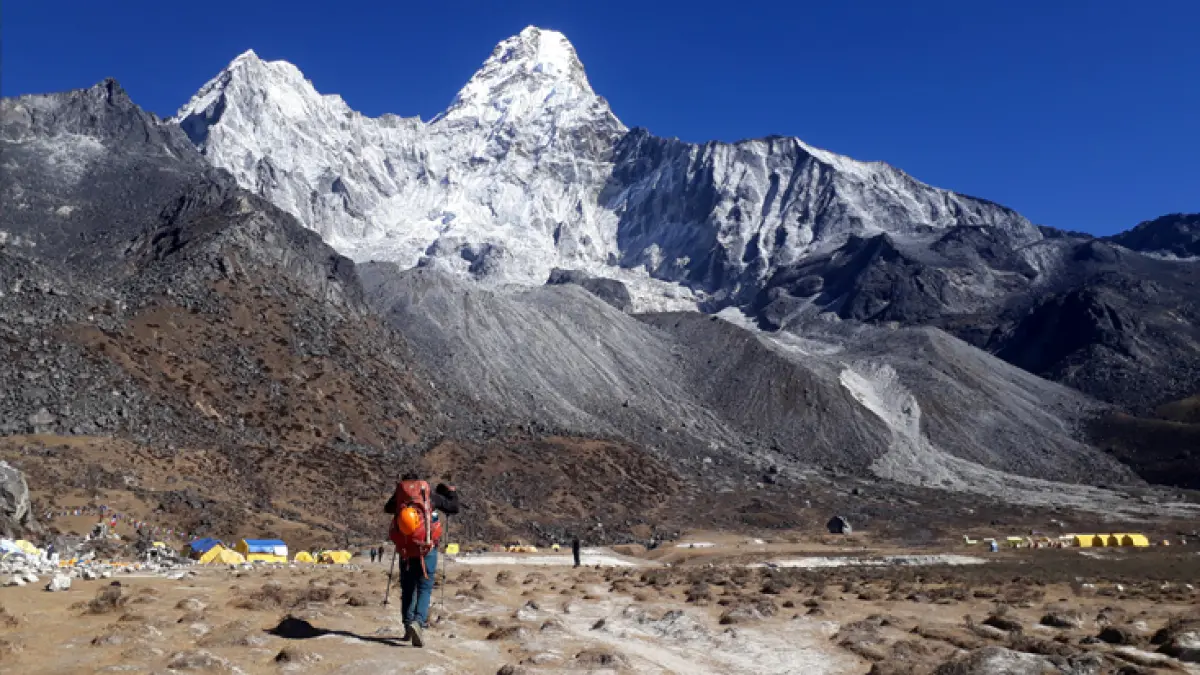
Our Ama Dablam Base Camp is at 4,600 meters on grassy terrain. The area is huge. Climbers even play volleyball or soccer to keep themselves warm and active.

Each season, there are around 7 to 10 climbing groups, so the Ama Dablam Base Camp is not too crowded. You will spend the longest time in base camp, so we make it as accommodating and comfortable as possible.

We will set up our permanent camp. There will be a crew of helpers, cooks, and doctors at the base camp to assist you during the expedition period.

Yak Camp (5,182 m/17,000 ft): 3-4 hours

Yak Camp is our second primary station, where we keep our heavy climbing gear and oxygen tanks. It is also a great point to acclimate between the base camp and Camp I.

From Ama Dablam Base Camp, you will climb along the southwest ridge to reach the Yak Camp. Our crew will take care of setting up the tents and making meals for you.

Camp I (5,700 m/18,800 ft): 3 hours 

From Yak Camp, Camp I is located close by. You will mostly walk on an easygoing rocky area that stretches around 100 meters. On the way, you can see huge rocks and also climb a simple fourth-class piece with no fixed rope set up.

Camp I is situated on a 60º slope. There is not much space on Camp I, so climbing groups have to coordinate with each other to set up the tents. Only 6 to 7 tents can fit at Camp I.

Camp II (5,950 m/19,521 ft): 3 hours 

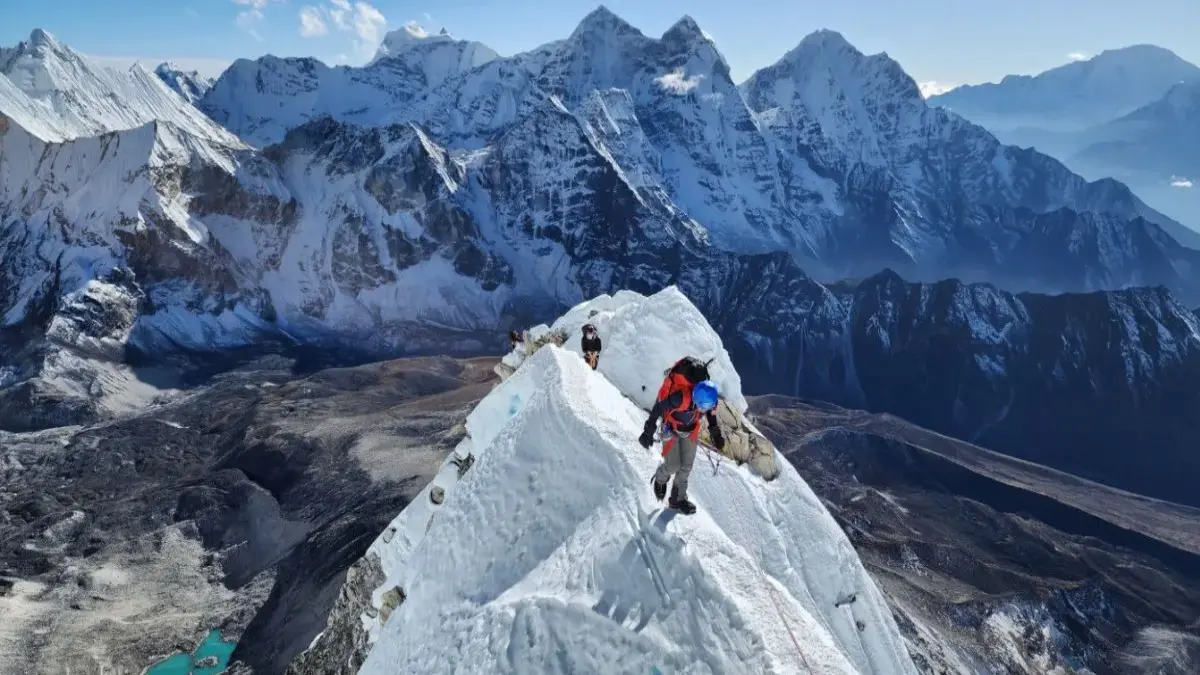
Camp I to Camp II is the most technical section of the Ama Dablam. Leaving Camp I, you will climb on a simple fourth-class level stone edge, gaining around 300 meters of elevation.

The exposure with massive drop-offs on both sides of the climbing route makes this area very thrilling. Towards the end of the level ridge, you will climb the Yellow Tower (6 meters tall).

It is considered as French Fourth Class, North American YDS 5.5, and British Severe. Upon climbing the Yellow Tower, you will feel the true height and high exposure on all sides.

Camp III (6,200 m/20,341 ft): 2 hours

The route between Camp II and Camp III on Mount Ama Dablam is mixed ice and snow terrain that you climb using fixed ropes throughout the way. Our Sherap team will fix the ropes and assist you during climbing.

You will see a spectacular view of Mt. Kantega, Mt. Kusum Kanguru, and a view of Ama Dablam Base Camp on the way. At 6,150 meters, you will cross the Mushroom Ridge and arrive at Camp III.

*Strong, experienced climbers usually go from Camp II to the Ama Dablam summit. But we make Camp III to provide our climbers one last break to prepare themselves before the summit push.

*Camp III has high avalanche risk, so we spend as little time as possible here.

*From Yellow Tower to Camp III, the route is 55º almost the whole way.

Summit (6,812 m/22,349 ft): 10 hours

From Camp III to the summit and back to Camp II, most climbers take around 10 hours. The summit push begins at around 12:00 AM. The route is already fixed with ropes by our Sherpa climbers.

On the way to the summit of Ama Dablam, you will climb two challenging snow pitches (40º+) on the Dablam side. Towards the end of the Dablam side, you will traverse a fluted 30º to 50º snowfield.

It leads to the summit of Mount Ama Dablam. The Ama Dablam summit is known as one of the most exquisite summits in the world. You will be surrounded by giants like Lhotse, Nuptse, Everest, Cho Oyu, Pumori, Makalu, and Shishapangma.

Ama Dablam expedition in spring and autumn comparison

We have made a table comparing the Ama Dablam expedition in spring and autumn below to give you a better idea and help you pick the best time for your trip:

Spring (mid-March to May)

Autumn (mid-September to November)

Fewer climbers

More climbers

A lot of snow and ice on the mountain

Snow and ice melt on the mountain

Added snow and ice challenges

Perfect climbing condition

Longer daylight hours

Shorter daylight hours

Comparatively cold climate

Warm climate and crisp, clean air

Chance of snow showers chance

Avalanche-prone on Camp III

Ama Dablam's difficulty and requirements

Like any other mountain, Ama Dablam has its own unique set of challenges and potential hazards. It is important that anyone planning to climb Mt. Ama Dablam possesses a strong high-altitude mountaineering experience and knowledge of alpine-style climbing techniques.

Mt. Ama Dablam is one of the highly technical mountains in the Himalayas. It involves a long climbing distance and hard multi-pitch climbing sections. Likewise, technical and belayed roping with protection is required on Ama Dablam.

While we take care of logistics and pair you with a strong, reliable Sherpa leader, it is crucial that climbers are in good shape and have a clear understanding of the technical aspects of the climb.

Climbing Ama Dablam is teamwork. Sherpas couldn't drag you up the mountain and bring you back. You have to actively participate and possess the necessary skills and experience.

  • You should know rope techniques, rock climbing, and ice climbing.
  • You must have climbed the 6,000-meter peak.
  • Ascending/jumaring on fixed-line and abseiling with a super 8 belay device or ATC descender in multi-pitch sections.
  • Climbing, scrambling, and traversing with crampons for long-duration on ice, rock, and snow surfaces.
  • Multi-pitch climb (rock or ice), rock climbing grade up to 5-9+/- to 5.10 a,b,c.
  • Performing snow arrest and safely getting back up if, by any chance, climbers slip and slide.

Ama Dablam expedition cost and 2026/2027 booking

Our Ama Dablam expedition cost is well-priced to offer the best service and safety without any compromise. Your money is secured with us. You will get the best value for your money by doing the Ama Dablam expedition with our team.

Our Ama Dablam expedition cost starts at USD 6000 per person. Bookings are open for the Ama Dablam expedition 2026 departure. Get your seat early to enjoy our special holiday price.

If you have any questions or confusion about our Ama Dablam expedition package or want to customize the Ama Dablam expedition itinerary, feel free to talk to our team.

We will be more than happy to assist you in curating a perfect Ama Dablam expedition for you and help you reach the summit of one of the most stunning mountains in the Himalayas safely and successfully.

Why climb Ama Dablam with Adventure Magic Treks and Expedition?

You will get IFMGA and NMA-certified mountain guides with us. Our 1:1 Sherpa/Client ratio ensures your safety during Ama Dablam climbing. We are one of the well-established trekking and expedition companies based in Nepal.

Our numerous years of expertise in the Himalayas make us a reliable climbing partner for Ama Dablam. We make sure every aspect of the Ama Dablam expedition is well organized, including permits, transportation, guide, porters, accommodation, meals, etc.

Likewise, we provide pre-climbing training at the Ama Dablam Base Camp and all essential information. Climbing with our team means you’ll not only reach the top of Mt. Ama Dablam but also learn a lot about technical climbing in the Himalayas.

Ama Dablam expedition is a lifetime opportunity for aspiring mountaineers, and climbing with a reliable partner like us makes the trip hassle-free, safe, and satisfying!

Ama Dablam Expedition Detailed Itinerary

1Day

Arrival in Kathmandu and transfer to the hotel

We will be at the airport to welcome you and transfer you to the hotel. You will stay in Thamel, the tourist hub in Kathmandu. Our team will help you with check-in. The rest of this day is leisure. So, you can take your time to relax and explore your surroundings.

Max Altitude: 1,324 m/4,344 ft
Meals: Null
Accommodation: Hotel
2Day

Rest and preparation day for the expedition

Today, you will spend the morning meeting with your expedition leader and learning the climbing plan. You will then spend the remaining day purchasing essentials for the expedition. If you have some downtime, visit nearby tourist sites such as Kathmandu Durbar Square or Monkey Temple.

Meals: Breakfast only
Accommodation: Hotel
3Day

Early morning flight from Kathmandu to Lukla airport and trek to Phakding (2,610 m/8,563 ft)

Trekkers should know that the Lukla flight is operated from Ramechhap Airport in the spring and autumn seasons. Likewise, in winter and summer/monsoon, the Lukla flight is operated from Kathmandu Airport.

It takes 4 to 5 hours to reach Ramechhap Airport from Kathmandu, so trekkers have to leave their hotel around 1:00 AM. We provide a private four-wheeler and our team's assistance.

In Lukla, you will meet the porter and start trekking right away. The trail descends around 200 meters to Phakding village, which is a must to avoid altitude sickness.

The trail goes through forested hills, following the Dudh Koshi River. On the way, you will cross many suspension bridges and pass by lovely settlements.

*Kathmandu to Lukla helicopter flight: For a comfortable flight, you can upgrade to a helicopter flight from Kathmandu to Lukla and vice versa. The helicopter flight costs around USD 650 to USD 750 per person.

Max Altitude: 2,846 m/9,337 ft
Meals: Breakfast, lunch, and dinner
Duration: 35 minutes flight & 3 hours trek
Distance: 6.2 km/3.8 miles
Accommodation: Lodge
Mode of Transportation: Lukla flight & trek
4Day

Trek from Phakding to Namche Bazaar

From today onwards, you will begin some serious walking. Have a delicious breakfast before leaving Phakding. The trail to Namche Bazaar gradually ascends along the Dudh Koshi River, crossing multiple suspension bridges on the way.

Crossing the Tenzing Hillary Suspension Bridge will be a big highlight of the day. It is long and swings a little when trekkers walk on it. Likewise, the permits are registered in Monjo, and from here you enter the Sagarmatha National Park.

The trail goes through rhododendron and magnolia forests all the way up to Namche Bazaar. Towards the final ascent, the trail is steep, so we recommend trekkers maintain their pace.

*You will see the first glimpse of Mt. Everest right before the final ascent to Namche Bazaar.

Max Altitude: 3,440 m/11,290 ft
Meals: Breakfast, lunch, and dinner
Duration: 6-7 hours
Distance: 7.4 km/4.6 miles
Accommodation: Lodge
5Day

Acclimatization in Namche Bazaar: hike to Hotel Everest View

Acclimatization days provide you a break to rest and adjust to the elevation. It increases trek success rate and lowers the chance of acclimatization. In Namche Bazaar, you will hike to the Hotel Everest View.

The hike is not that tough, and you are rewarded with mesmerizing views of Mt. Thamserku, Mt. Everest, Mt. Lhotse, Mt. Nuptse, etc. Likewise, you will also explore museums, shops, and cafes in Namche Bazaar.

Max Altitude: 3,962 m/13,000 ft
Meals: Breakfast, lunch, and dinner
Duration: 4-5 hours
Accommodation: Lodge
6Day

Trek from Namche Bazaar to Tengboche village

Continuing the trek from Namche Bazaar, you will hike to Tengboche village. The trail is flat for the first hour and then descends to Phungi Thenga. You will cross a suspension bridge and ascend for 2-3 hours to reach Tengboche village.

Tengboche village is home to the largest monastery in the Khumbu region, known as Tengboche Monastery. Likewise, the view of Mt. Everest and Mt. Ama Dablam is stunning from the back of the monastery.

Max Altitude: 3,860 m/12,660 ft
Meals: Breakfast, lunch, and dinner
Duration: 5-6 hours
Distance: 9.2 km/5.7 miles
Accommodation: Lodge
7Day

Trek from Tengboche to Pangboche

Leaving Tengboche, you will descend to Deboche village via the rhododendron forest. The trail descends to the Imja Khola Valley Floor. You will cross a suspension bridge and ascend to Pangboche village through forested hills. In Pangboche village, you will explore one of the oldest monasteries of the Khumbu region.

Max Altitude: 3,985 m/13,074 ft
Meals: Breakfast, lunch, and dinner
Duration: 2-3 hours
Distance: 4.5 km/2.7 miles
Accommodation: Lodge
8Day

Trek from Pangboche to Ama Dablam Base Camp

From Pangboche, the trail to Ama Dablam Base Camp is different. You will follow a peaceful route following the Imja Khola and hike to the base camp of Mt. Ama Dablam. The terrain is rocky. You may come across fellow climbing parties on the way.

Our support crew will already be at the Ama Dablam Base Camp, ready with tents and warm food to welcome you. You will meet with our base camp crew and settle in.

Max Altitude: 4,600 m/15,092 ft
Meals: Breakfast, lunch, and dinner
Duration: 3 hours
Distance: 5 km/3 miles
Accommodation: Camp
9-27Day

Climbing period - summit Ama Dablam and return to Ama Dablam Base Camp

From the 9th to the 27th day, there will be acclimatization and climbing periods. You will spend a handful of days at the base camp to acclimatize and go on climbing rotations to the higher camp.

After the Ama Dablam Base Camp, we make a Yak Camp at 5,182 meters, where we will store our heavy climbing gear and oxygen tanks. Then, we will make three more higher camps: Camp I (5,700 m), Camp II (5,950 m), and Camp III (6,200 m).

From Camp III, we will push to the Ama Dablam summit (6,812 m). After the summit push, you will follow the same route and descend to Ama Dablam Base Camp. On the way, we clean the camps and bring our waste down the mountain.

Max Altitude: 6,812 m/22,349 ft
Meals: Breakfast, lunch, and dinner
Accommodation: Camp
28Day

Trek from Ama Dablam Base Camp to Namche Bazaar

It is time to return. Leaving Ama Dablam Base Camp, you will trek back to Pangboche village. The trail then ascends through lush forest to Tengboche village. From here, you will descend to Phungi Thenga and hike to Namche Bazaar.

Max Altitude: 3,440 m/11,290 ft
Meals: Breakfast, lunch, and dinner
Duration: 7-8 hours
Distance: 19 km/ 12miles
Accommodation: Lodge
29Day

Trek from Namche Bazaar to Lukla

Leaving Namche Bazaar, you will follow a steep downhill path and walk through lush forest to Phakding. From here, you will ascend to Lukla, crossing several suspension bridges on the way.

Max Altitude: 2,846 m/9,337 ft
Meals: Breakfast, lunch, and dinner
Duration: 8 hours
Distance: 13.6 km/8.3 miles
Accommodation: Lodge
30Day

Morning flight back to Kathmandu from Lukla airport & hotel drop

Today, you will take a morning flight back to Kathmandu. You will either land at Ramechhap Airport or Kathmandu Airport. Our team will escort you from the airport to your hotel.

Spend the remaining day as you wish. We recommend getting a massage. Likewise, explore the nearby tourist sites and enjoy window shopping in Thamel.

We may meet in the late evening for a farewell dinner and also hand over the trekking certificate to you.

Max Altitude: 1,324 m/4,344 ft
Meals: Breakfast only
Duration: 35 minutes flight
Accommodation: Hotel
31Day

Free day in Kathmandu

You have a free day in Kathmandu. Rest and buy souvenirs. Visit tourist sites and try Nepali food. We highly recommend getting a trekker's/climber's massage. It will help you a lot with exhaustion and body pain.

Meals: Breakfast only
Accommodation: Hotel
32Day

Final departure

Our team will transfer you to the airport. Feel free to leave your feedback with us. We hope to welcome you again in Nepal for your next adventure.

Meals: Breakfast only
Still Confused? Let Us Guide You
No worries — we’re here to help. Whether you have questions or just need a bit more clarity, feel free to reach out. Our team is ready to guide you every step of the way.

Ama Dablam Expedition Cost

What’s Included

  • IFMGA or NMA certified guide leader
  • 1:1 Sherpa/Client ratio
  • Porters as per group size
  • Head chef and kitchen helpers
  • Government Liaison Officer expense and salary
  • 3-night stay in Kathmandu in a nice tourist-standard hotel
  • Lodge accommodation during trekking
  • Camping at Ama Dablam Base Camp and higher camps
  • Breakfast in Kathmandu
  • Three meals a day during the trek and climbing period
  • Solo tent at Ama Dablam Base Camp and 2-person tent at higher camps
  • Full board service at base camp (including solar power for charging, daily weather forecast updates)
  • All trekking and climbing permits
  • 2 flights between Kathmandu and Lukla
  • Airport pickups and drop-offs as per the itinerary
  • 30 kg personal weight (for additional weight, clients can hire a porter - estimated USD 1000 for 32 days)
  • Burners and expedition equipment
  • Walkie-talkie/Satellite phone
  • Supplemental oxygen cylinder for emergency use only (Personal O2 system can be arranged at $550 P/P with 1 bottle and 1 regulator system)
  • Basic first aid kit
  • Adventure Magic Treks merchandise (down jacket, cap, buff, duffel bag)
  • Trip achievement certificate
  • All government taxes and service charges

What’s Excluded

  • Nepal travel visa
  • Travel insurance
  • International flights to/from Kathmandu
  • Tip for porters and support crew (at least USD 150 per person)
  • Summit bonus (at least USD 500 per climbing Sherpa guide)
  • Lunch and dinner in Kathmandu
  • Bottled drinks and beverages (bar bills)
  • Climbing clothes and gear
  • Satellite phone bills
  • Departure taxes
  • Any expense not mentioned in our Cost Include section

Dates and Availability

Select Departure Date
  • Contact us for a private Ama Dablam expedition trip or customize the itinerary.
  • You can hire additional porters and support team at a good price with us. 
  • We can also combing multi peak climbing in one trip. 

Equipment Lists

Download Equipment Lists

Essential Information

The best time to climb Mt. Ama Dablam 

Spring (mid-March to May) and autumn (mid-September to November) are the two best times to climb Ama Dablam. Both seasons have different climbing conditions.

In general, autumn is the busiest time of the year for Ama Dablam climbing. Autumn sees 70% more climbers than spring because there is more snow/ice on the mountain in spring.

In contrast to that, the daylight hours are longer in spring than in autumn. Overall, the Mt. Ama Dablam summit is accessible in both spring and autumn, but both seasons have their pros and cons.

Spring (mid-March to May):

Snow is more on Mt. Ama Dablam in spring. Climbers get to test their endurance and push their limits on the fresh, deep snow. Only a few climbers climb Ama Dablam in spring, so there is no crowd.

Tackling the notorious Yellow Tower and the vertical, exposed section of Mt. Ama Dablam during a minimal crowd is an experience you shouldn't miss. On top of that, the weather is best in the spring season. Stable weather and clear sky increase summit success.

Autumn (mid-September to November):

Autumn attracts most climbers to Ama Dablam. The snow and ice melt during the summer/monsoon period. You can see the granite rock formations while climbing.

Autumn is the post-monsoon period. So, you will experience clean and crisp air and stunning views. As most snow melts by the start of autumn, you will have favorable climbing conditions. The daylight hours are comparatively shorter than in spring.

Ama Dablam acclimatization plan

From the day 9th to the 27th will be your acclimatization and summit push period. You will spend most of your time at the Ama Dablam Base Camp and go on acclimatization rotations to Camp I and Camp II.

Acclimatization rotation is great for adapting to the alpine environment and also learning the climbing route. We will have a doctor at the base camp to monitor your health and help you if you feel sick.

It is important that you are well adapted to the high altitude before we begin our final summit push. So, we do not rush and take our time to acclimatize. The Ama Dablam Base Camp is a huge grassy area.

Climbers play volleyball and football here, which is great to keep them active. Likewise, your team leader will also organize multiple training sessions to make sure you are ready for the final push.

Below are some tips that will help you acclimatize during the Ama Dablam expedition:

  • Do not skip acclimatization hikes.
  • While ascending to Ama Dablam Base Camp, take your time and maintain a steady pace. Do not rush.
  • Have ample food and get 8+ hours of sleep each day.
  • Drink plenty of water, soups, and ginger-honey teas daily. You have to keep yourself hydrated.
  • If you feel sick or see symptoms (such as headache, nausea, vomiting, breathlessness, insomnia, and loss of appetite), inform your guide. You have to take medicine and rest. In some cases, descending a couple of hundred meters also helps.
  • Do not drink alcohol or smoke.

What kind of travel insurance is required for the Ama Dablam expedition?

The Himalayas are quite unpredictable. You never know what may go wrong. No matter your fitness, preparation, and past experience, you can get sick or hurt or face sudden, drastic weather change.

These things are beyond our control. We provided first aid, but for more medical assistance, evacuating to Kathmandu is necessary. Likewise, if there is a sudden avalanche or natural disaster, we have to leave the mountain and return to Kathmandu immediately.

For unforeseen circumstances like this, travel insurance covering helicopter evacuation is a must. It is your backup. Every climber must have proper travel insurance for the Ama Dablam expedition. Without travel insurance, climbing permits are not issued.

Accommodation and meals during the Ama Dablam expedition

In Kathmandu, we will book a nice tourist-standard hotel for you to spend the night. Once you are in the mountains, you will spend nights in simple lodges till Pangboche. At Ama Dablam Base Camp and higher camps, we provide alpine tents.

Every climber gets a single sleeping tent with a foam mattress and a pillow. In addition to that, there will be a dining tent, kitchen tent, communication tent, toilet and shower tent, staff tent, and store tent.

At base camp, we will have all the cooking, fuel, food, water, and other essentials. We prepare everything at the base camp and send it to the higher camp. There will be a table, chair, and all other necessities. Likewise, the dining tent will be heated.

  • Kathmandu: In Kathmandu, we only provide breakfast. Food from all around the world is found in Kathmandu. You can have lunch and dinner as per your wish.
  • During trek: During trekking, you will get three meals a day as per the menu of the lodge.
  • Climbing period: While climbing, we provide three meals a day. We customize a high-energy menu for the climbing duration.

*In Kathmandu and during trekking, rooms are booked on a twin-sharing basis.

*Single rooms are provided at an extra charge.

*If you have any allergies, let us know during booking. We will curate the menu for the climbing duration according to that.

How many climbers will be there in your group?

There will be a minimum of 2 and a maximum of 8 climbers in our fixed departure Ama Dablam expedition group.

Can your friend or family join you on the trek to Ama Dablam Base Camp?

Yes, your friend or family can join you on the trek to Ama Dablam Base Camp. We will arrange permits and accommodation for them. Kindly talk to us for more information and pricing.

How much should you tip your guide and porter crew?

We recommend budgeting USD 800 to USD 1,200 to tip the guide and the support crew. You can tip them at the end of the climb.

In addition to money, guests also like to donate jackets, trekking poles, gloves, and hats. You can also buy them good food and drink for their hard work in Namche Bazaar or Lukla.

Can you bring other climbers to join you for the Ama Dablam expedition?

Yes, you can bring other climbers to join you for the Ama Dablam expedition. In fact, we encourage climbers to have a climbing friend to share the journey and challenges. It is not necessary, but if you have a climbing buddy, we highly recommend climbing together.

Is a private Ama Dablam expedition possible?

Yes, you can do a private Ama Dablam expedition with us. Note that a private expedition can cost a little more because you have to bear all the logistics expenses by yourself. For more information about a private Ama Dablam expedition, feel free to talk to us.

Is a shower and a laundry available during the expedition?

You will have access to a hot shower and laundry in the lodges during trekking. At the Ama Dablam Base Camp, we can arrange hot showers and laundry service, but it will be limited. No hot shower or laundry service is available above the base camp.

How do you charge your device?

We provide electricity through solar panels. We will build battery charging stations for the group. Keeping our expedition equipment charged, such as radios and satellite phones, is our first priority. Nevertheless, there will be enough power to charge your personal devices.

Do you need to get a Nepal travel visa?

Yes, foreigners (except Indians) need a Nepal travel visa. You can obtain an on-arrival travel visa upon arriving at Kathmandu Airport or any border entry points.

Likewise, you can also get your Nepal travel visa issued through the Nepalese Embassy or Consulate Office in your country.

Our Ama Dablam expedition package does not include the travel visa fee. You can learn more about the Nepal travel visa on this site.

Will there be any additional expenses during the Ama Dablam expedition?

You will need some money for extra personal expenses during trekking, like WiFi, charging, and a hot shower. At Ama Dablam Base Camp, you will mainly need some money for the satellite phone bill and tips for the guide and porter.

What type of sleeping bag is recommended for the Ama Dablam expedition?

You need a high-quality four-season goose down-filled sleeping bag that can handle up to -40C. Buy a big sleeping bag so that you can sleep in it wearing extra clothes.

*You can rent a sleeping bag for the journey in Kathmandu at a very affordable price.

Can you use our satellite phone to stay connected with your family during the climbing period?

Yes, you can use our satellite phone to stay connected with your family and friends during the climbing period. However, it will cost you around USD 3 per minute.

Luggage weight limit for the Ama Dablam expedition

We allow up to 30 kg of personal weight for each climber. You will pack the majority of your climbing gear and essentials in a duffel bag, which is carried by our porter. One porter carries up to 18 kg.

*If you have any extra luggage, you can store it in our office for free during the trip duration. Likewise, you can also store it in your hotel's locker room for free. 

Ama Dablam Expedition FAQs

Q1.

What makes the Ama Dablam Expedition unique compared to other Himalayan climbs?

Ama Dablam is known as one of the most stunning mountains in the world. Even though Ama Dablam is not an 8,000-meter mountain, the technical challenges it offers are no less.

The exposed climbing route and the overall mountaineering experience that Ama Dablam presents attract passionate climbers from all around the globe.

Q2.

How difficult is the Ama Dablam Expedition?

The Ama Dablam expedition is very demanding. It is a physically, mentally, and technically challenging mountain in Nepal. To climb Mt. Ama Dablam, you need two or more 6,000-meter climbing experiences along with knowledge of rock climbing, ice climbing, and technical climbing gear.

Q3.

What is the best season for climbing Ama Dablam?

The best season for climbing Ama Dablam is spring and autumn. Among these two seasons, autumn is most famous because of the clear climbing route. In spring, there is deep snow and slippery ice on Ama Dablam.

Q4.

Do I need previous mountaineering experience to climb Ama Dablam?

Yes, you need previous mountaineering experience to climb Ama Dablam. You will need:

  • 2 or more 6,000-meter climbing experiences
  • Multi-pitch climbing skill
  • Rock climbing and ice climbing
  • Outside of Nepal, you can have experience on Aconcagua and Mt. Blanc or any simple 4,000 to 6,000-meter peaks
Q5.

What technical skills are required for the Ama Dablam expedition?

You will need the following technical skills for Mt. Ama Dablam:

  • Figure 8 know and stopper knot
  • Ascertaining on fixed-line and abseiling with a super 8 belay device or ATC described in a multi-pitch section
  • Climbing, scrambling, and traversing with carabiners
  • Rock climbing (grade up to 5-9+/- to 5.10 a,b,c)
  • Ice climbing (WI-3 to WI-4 required for Spring Ama Dablam expedition)
  • Can perform snow arrest and safely get back up if the climber slips and slides by chance
Q6.

What is the success rate of reaching the Ama Dablam summit?

We have seasons when we saw a 100% success rate of Ama Dablam. Likewise, we also had a few seasons when only 90% of our climbers reached the summit of Ama Dablam. Overall, our Ama Dablam success rate is above 90% but your preparation and weather play a huge role.

Q7.

What is the standard climbing route for Ama Dablam?

The standard climbing route for Ama Dablam is the Southwest Route. This route is used even during the first successful summit of Mount Ama Dablam in 1961.

Q8.

How many camps are used during the Ama Dablam climb?

Above the Ama Dablam Base Camp, we make a semi-permanent Yak Camp at 5,182 meters to store our heavy climbing gear and oxygen cylinder. Then we made three more camps between Yak Camp and Ama Dablam summit- Camp I (5,700 m), Camp II (5,950 m), and Camp III (6,200 m).

Q9.

How many days does it take to reach Ama Dablam Base Camp?

From the Ama Dablam Base Camp, you can reach the Ama Dablam summit in 3 to 4 days of climbing. But due to high altitude and to avoid mountain sickness, we spend an extended number of days at the base camp to acclimatize.

Q10.

What is the acclimatization schedule for Ama Dablam?

We spend an acclimatization day in Namche Bazaar and a handful of days in Ama Dablam Base Camp before the summit push. During our acclimatization period at the base camp, we will go on acclimatization rotations to higher camps.

Q11.

Are there alternative routes for Ama Dablam?

  • The Southwest ridge is the standard route to the Ama Dablam summit.
  • The North Ridge is less traveled and technical than the southwest ridge. It is more exposed to wind and avalanches and is only recommended for an expert climber.
  • The East ridge is rarely attempted because of high hazards and complicated access. This route is only used by elite climbers attempting new variations.
  • The West ridge (West Face) is another high-risk route with fewer documented summits. Not suitable for commercial expeditions.
  • South Face, also known as Big Wall Style, is a rarely used route. Very low success rate and hazardous route.
Q12.

What permits are required for the Ama Dablam Expedition?

You will need the following permits for the Ama Dablam expedition:

  • Ama Dablam climbing permit
  • Khumbu Pasang Lhamu Rural Municipality Permit
  • Sagarmatha National Park Permit
  • Garbage Deposit (Refundable)
  • Liaison Officer (LO) Assignment

*All of these permit fees are covered in our Ama Dablam expedition cost.

Q13.

How physically fit should I be to climb Ama Dablam?

For the Ama Dablam expedition, you need to have a strong foundation of technical alpine climbing, previous 4,000-meter to 6,000-meter mountain experience, and strong physical and mental fitness.

Q14.

How early should I start preparing for Ama Dablam?

It depends on your experience, knowledge, and fitness. You cannot climb Ama Dablam with just a few weeks of exercise. You need to climb a few other smaller peaks and at least one 6,000-meter peak.

Likewise, you need rock climbing, ice climbing, and technical mountain climbing knowledge. So, see where you stand and book your expedition according to that. Talk to us for more clarity.

Q15.

How experienced are the Sherpa climbing guides?

We provide veteran Sherpa leaders for the Ama Dablam expedition who have previously summited Ama Dablam and have led other climbers. You will be climbing with a very experienced, knowledgeable, strong, and reliable Sherpa guide.

Q16.

What safety measures are taken during the expedition?

During the expedition, we ensure you are well acclimatized and in good condition before the summit push. We provide high-energy food to keep you going at high altitude.

Likewise, our base camp doctor monitors your health throughout the expedition. On the other hand, our rescue team stands by during the expedition. We carry first aid and supplement oxygen cylinders and vet the climbing route before we put our climbers on the mountains.

Q17.

Is avalanche or rockfall risk common on Ama Dablam?

In the autumn season, Camp III has a high avalanche risk, but in general, it is avoidable.

Q18.

What happens if someone gets sick or injured during the climb?

If someone gets sick or hurt during climbing, we provide first aid. If they do not get better with the first aid, we will descend and see the progress. If there is still no progress, we will bring the climber back to Kathmandu via helicopter for more medical care.

Q19.

Are helicopter services available to and from base camp?

Yes, helicopter services are available to and from Ama Dablam Base Camp. It will cost you USD 750 to USD 950 per person.

Q20.

Is satellite communication available at Base Camp?

Yes, our group carries a satellite phone during the expedition for emergency communication with the office team in Kathmandu.

Likewise, our group uses walkie-talkies to stay connected to the base camp leader once they move to the higher camps. 

Q21.

How long does the Ama Dablam Expedition take?

Our Ama Dablam expedition itinerary is 32 days long. If you are a veteran climber and do not need much time for acclimatization, we can customize the itinerary.

Price From
US$6000
US$6500
8% Off
Group Discount Price +
  • No. of travelerPrice per person
  • 1 paxUS$6500
  • 2 - 5 paxUS$5500
  • 6 - 10 paxUS$5000